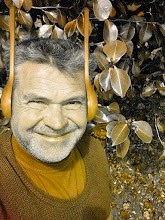
I have always been slightly bewildered by the term "predatory male" to describe a man who is enthusiastic in desiring (and proactive in attempting to secure) sexual relations with a woman. A predator, in my understanding, is a creature that hunts and eats another creature; the result is that the eaten creature always dies. This metaphor seems at best a little extreme when applied to a man who simply is willing to exert energy and brainpower in order to persuade a woman to jump into bed with him. Romance is supposedly the prelude to the pounce. And yet I have never witnessed a lion taking a zebra out for a candle-lit meal.
It is often said that the writer H.G. Wells was a predatory male. There seems to be a general consensus that this is true. Really? Let's take a look at him compared with a cheetah. Forgive me if I lack imagination but I can't picture Mr Wells reaching speeds of between 112 and 120 km/h in short bursts over the African savannah, accelerating from 0 to over 100 km/h in three seconds. I can't even picture him attaining 20 km/h on his way to a newsagent's in Bromley. Would Wells even have been capable of catching a young fleet-of-foot woman, let alone an impala? I doubt it. I do, however, recommend his books, including his unjustly neglected later works such as Mr Blettsworthy on Rampole Island, The Autocracy of Mr Parham and the especially marvellous Christina Alberta's Father...
Another point: a cheetah has an average killing success of 50%. This compares unfavourably with the wild dog's average of 80% but favourably with a lion's average of 30%; a tiger's average may be as low as 10%. Now let's consider the success rate of the so-called "predatory male". In my life, like almost all men throughout history, I have chased women. I have managed to entice a certain number into bed (it would be tasteless to specify an exact figure; let's just say that it's a positive integer that equals twice the sum of its decimal digits). If we divide the number of women I have attempted to get into bed with by the number I have succeeded in getting into bed, my success rate is 0.00375%. Any true predator with such an abysmal average would surely evolve into a herbivore!
So let's drop this unhappy phrase, "predatory male". Let us simply speak of "normal males" or just "males".
Ex Occidente recently published a tribute volume to the great Russian writer Mikhail Bulgakov. I was delighted that one of my own stories was chosen for inclusion... Bulgakov was an amazing writer, one of the finest of the 20th Century. Best known for the satirical novel The Master and Margarita, his oeuvre in fact encompasses a huge variety of styles.
Anyway, the tribute anthology is limited to only 100 copies. It is probably the finest book I have ever been published in. It's available from the publisher here. Originally it was planned that each of the contributors would write a set of notes explaining why they decided to write the stories they did. In the end, it was felt that such notes might prove a little distracting. After all, the main focus of this anthology is Bulgakov!
However, I here take the liberty of posting the notes I prepared for my own contribution, a story entitled 'The Darkest White'.
Notes for 'The Darkest White' (Bulgakov tribute story)
I once had a Russian girlfriend named Margarita; and it was she who was responsible for introducing me to the work of Bulgakov. The coincidence of names isn't a mandatory requirement of some fussy God of Literature. We don't need girlfriends named Thérèse or Eugénie to discover Zola and Balzac, and indeed it might even prove a hindrance.
But one result of my initiation in this manner was that I came late to Bulgakov. A dreadful shame! From the very beginning of my discovery that reading novels is an important pastime, I worshipped the Russians. I devoured Tolstoy's War and Peace when I was fourteen, following it with more Tolstoy and works by Pushkin, Gogol, Chekhov, Dostoyevsky and Sologub. The old Russians were authentic masters.
But I was suspicious of the Soviets, the moderns, for I had made the curious mistake of assuming that any writer who lived and worked in the USSR must, like Gorky, Sholokhov or Paustovsky, be a propagandist for an abhorrent political system. It simply never occurred to me that an author who remained inside the nightmare (through the ill luck of being born at the wrong time or lacking the resources to flee) might only appear on the surface to be working for the state, and that their true, secret work might be against the insanity and injustice.
Thus I was blind to a great deal of courage and genius; and I remained ignorant of the words of Kharms, Mandelstam, Vvedensky, Zamyatin, Babel and all the others. So when I did finally come to Bulgakov it was somewhat in the manner of a penitent, on my mental knees, so to speak. And that is still my posture. When I was asked to write a tribute story to him, I was intimidated: he was too great to look in the eye. I considered missing the chance to write a tale in his honour. I lacked the effrontery; at least I thought I did.
My answer was to be found in an oblique approach. I used Bulgakov as a frame around a different kind of tale, a story inspired by yet another great writer of that era: Lev Nussimbaum (alias Essad Bey, alias Kurban Said). After all, Bulgakov was fond of the framing device, and he spent time in the Caucasus during the tumultuous events that Nussimbaum also endured. I like to imagine they met in some café on the shores of the Caspian. Probably they didn't; but the picture is pleasing to me. I wanted my framing device to lead to a story that led back to the framing device; so Bulgakov and Nussimbaum do meet at last, indirectly, across time as well as space, and almost on the page.
'The Darkest White' is perhaps the most overtly political story I have ever written. I am strongly anti-communist, for I have travelled widely in lands that once groaned under communist regimes, and from Albania to Angola I have seen the damage caused. Had I lived during the Russian Civil War I like to think I would have had the courage to fight on the side of the Whites; and yet I am not pro-Tsar, and the belief that all opponents of Bolshevism were supporters of the monarchy is indolent and ignorant. Bulgakov himself has been cited as a Tsarist. This accusation is absurd. The Whites were a loose gathering of anti-Bolshevists who came from a very broad spectrum of political positions, some of them more genuinely 'socialist' than the Reds. I hope my story helps to show the sheer diversity of the resistance to the nightmare.
The most interesting independent fiction publisher to have arisen in the past year or two is Chômu Press. I suspect the word 'Chômu' has a specific meaning, maybe something to do with Japanese aesthetics or fin de siècle decadence, but I'll be dashed if I know what that meaning is -- and I don't dare ask the publishers because I don't want to look more ignorant than I already am. The little hat over the letter 'o' makes it more tricky than usual to keep writing the name, but it's worth it. Chômu, Chômu, Chômu... Without that hat the word might get wet when it rains.
Chômu Press have just released their tenth book. Let's have a quick look at each of these in turn. First up, we have Remember You're a One-Ball by Quentin S. Crisp. The title (I presume) is a punning reference to the old Wombles song. When I was younger I misunderstood the lyrics. "The Wombles of Wimbledon / Common are we." Because of the phrasing I thought that the Wombles were from Wimbledon (the town) and that they were common; but in fact they are from Wimbledon Common and no comment concerning their scarcity was intended. I had the pleasure of once meeting Quentin S. Crisp and I wrote about that encounter here. His writing style is superb. He does many fine things in his writing, but there's one quality especially that catches my attention. His forceful clarity. He has a skill that many writers don't have: the ability to upload almost instantly whatever it is he wants to say into the reader's brain. There may be ambiguity of effect but there's never any ambiguity of clarity with his prose style. Ballard does this very well; M.John harrison, Marguerite Duras, Boris Vian, Ernesto Sabato, a handful of others.
The second and third Chômu books were I Wonder What Human Flesh Tastes Like by Justin Isis, and The Dracula Papers, Part 1 by Reggie Oliver. I suspect that the Oliver volume is the best-selling Chômu title so far (I might be wrong about that). Quentin S. Crisp once emailed me to say that Justin Isis was one of the best living writers. That's high praise indeed from a man of Crisp's taste and discretion. As for Reggie Oliver: I am reliably informed that he's excellent. Personally I'm not a big fan of anything to do with vampires, but so what? Both books should adorn the shelves of any progressive horror fan. Are you a progessive horror fan? if so, maybe you ought to consider purchasing one or both...
Revenants by Daniel Mills has attracted considerable attention as a thoughtful and original historical novel. Here's a quote from the hugely influential Booklist: "Readers [of Revenants] are swept into the towering forests of colonial New England right along with the settlers as Mills calls up both the majesty of stately oaks and chestnuts and mist-laden scenes of terrified Native American women and children who were slaughtered where they stood. Otherworldly fiction from a promising new talent..." As for The Life of Polycrates and Other Stories for Antiquated Children by Brendan Connell, what can I say? Connell, in my view, is perhaps the best contemporary master of the weird. Only Cisco rivals him. Connell's ideas are always brilliant, his style is clear but lyrical, his story structures are immaculate. Frankly, he's a wonderchild. He really deserves to be read by everybody. That's all I plan to say about him for now...
Mark Samuels. I dislike the man personally (or rather: I dislike some of the things he says and does) but what does that have to do with his writing? Nothing! The Man Who Collected Machen is one of his best books, so I've been told. The thing about Samuels is this: somehow he has tapped into something that deeply affects people, he doesn't just get under their skin (almost anyone can do that) but under their souls, and that takes pure talent. Years ago, Samuels told me that he didn't want to be a horror celebrity and win awards in the present but that he'd much rather write one story that was still remembered one hundred years from now. One story, just one. Turns out he was being accidentally modest. It seems a safe bet to say that he has already exceeded his ambition by several orders of magnitude!
Michael Cisco: genius. I'm not alone in thinking this. Thomas Ligotti believes it to be so, Jeff VanderMeer too. Cisco = genius. Simple equation. Good that it's simple because nothing about his writing is. That doesn't mean that his work is murky or obtuse; it's not 'complex' or 'difficult' in that way. No, it's mind expanding, authentically so. I liked The Great Lover so much I wrote the Introduction for it... As for John Elliot's Dying to Read, I'll state that there's just one kind of crime fiction I'm a fan of: the offbeat kind. I like 'Death and the Compass', the novels of Friedrich Dürrenmatt, Don't Point That Thing at Me by Kyril Bonfiglioli, etc. Elliot's novel can be joyously put in amongst those works. It's very offbeat, very funny and very original...
What can I say about my own book? Link Arms With Toads! is a collection designed to be a comprehensive 'sampler' of the totality of what I do, so it runs the full spectrum of all the genres I've attempted, and is therefore probably the best entry point for readers new to my work... Most of my other books are biased to specific genres, but this one is biased only to its own syncretist aesthetic. Get your laughing gear around that! It features 18 stories, the earliest dating from 1994 and the most recent from 2010. One of the stories, 'Hell Toupée', is one of my own personal favourites, perhaps in the top 10 of all the stories I've written. Another tale, 'Discrepancy', provides the ultimate "key" to all my other fiction and in fact justifies the entire projected cycle of 1000 interlinked stories that I plan to write.
Enough of that! Let's look quickly at D.F. Lewis' Nemonymous Night. Lewis is one of the most eccentric figures in the independent writing world. Most of the time I have no idea what he's talking about. His work is non-algorithmic and non-systematic. It should be nonsense and yet... it evokes a particular kind of atmosphere, a unique ambience, that no one else can do. It shouldn't work but it does! The simple truth of the matter is that after Lewis is dead he'll get a blue plaque on his house. Most other writers won't. That says a lot, I think... I can't really say anything about Joe Simpson Walkers' Jeanette because it hasn't been published yet. Indications are, however, that it's a transgressive novel along the lines of The Story of O. Let's wait and see! A writer by the name of Joe Pulver also has a book due out from Chômu at the end of 2011, but that doesn't have a cover yet. I may talk about it when it's published.
Chômu Press deserves to flourish. But before they can flourish they deserve to survive. Please consider buying at least one of the above books from them. It's a tough economic climate at the moment for everybody and publishers are especially vulnerable to the bite of the recession. Buy a Chômu book and help keep excellence alive. Thank you!
This is going to look like I'm showing off, but I'm not really. I'm just delighted to report the fact that in the past six months I've had no less than five books published; and if it's permissible to count the two ebooks (The Phantom Festival and Scamps of Disorder) that also appeared in that timespan, then my total is 7 books in 6 months (but ebooks don't actually count)...
This is a photo of the five books in question. They are the ones standing with their front covers facing forward (much as I'd like to take the credit, I'm not responsible for Italo Calvino's Numbers in the Dark, John Sladek's Complete Roderick, Jack Vance's Alastor or Stanislaw Lem's Cyberiad)...
From left to right my five books are: (a) Mister Gum, an obscene satirical novel, 2nd edition, (b) Worming the Harpy, definitive version, (c) The Brothel Creeper, hardback (there's a paperback version available), (d) Link Arms With Toads! and (e) The Coandă Effect. Next month (or the month after) may see the publication of yet another book, Sangria in the Sangraal.
And later in the year it's possible that I might have two more books out: Tallest Stories and The Impossible Inferno. If this does indeed happen, 2011 will be my most successful writing year ever!
The recent death of the actress Elizabeth Taylor has reminded me that when I was younger I saw some novels on the shelves of my local library apparently written by her. This astonished me. "I didn't know she wrote fiction!" I said to myself. She didn't, of course. It was a different Elizabeth Taylor.
Even back then I felt that something about this situation was unfair. The actress had usurped the other Elizabeth Taylor's name, consigning the writer to oblivion. As it happens, that's not quite true: Elizabeth Taylor still has her dedicated readers (Roald Dahl was one enthusiast). However, if someone speaks the two words "Elizabeth" and "Taylor" in succession, it's a safe bet that most people will assume the speaker is referring to the actress, not to the author.
Coincidentally, the actress's husband played the same trick on another historical figure. When I first read in an encyclopedia that the first European to see Lake Tanganyika was Richard Burton I was truly amazed. Apparently he was looking for the source of the Nile at the time. The idea that a drunken Welsh thespian might even be able to find his way up the River Taff in Cardiff was remarkable enough. But to journey up the Nile? I scarcely believed it!
Naturally, it was a different Richard Burton... The explorer is still justly famous. Nonetheless, if someone speaks the two words "Richard" and "Burton" in succession, it's a safe bet that most people will assume the speaker is referring to the actor, not the explorer. Again, this seems grossly unfair.
Recently, someone told me that they greatly enjoyed the novels of Rosemary Sutcliff. My first reaction was to exclaim, "What? They allow her to write books in prison? And make money from them? Outrageous!" I was confusing her name with the names of two serial killers. I know who she is now, but I still think she sounds like a psychopathic murderer. Might as well be called Myra Ripper or Jack the Shipman...
I have long been obsessed with the horrible thought that someone with the same name as me might come along and do something far more remarkable and/or notorious than anything I have ever done, thus appropriating my name for themselves. I have worked hard to make a name for myself as a writer. To be displaced overnight by a different Rhys Hughes would be a dreadful fate; consignment to oblivion in such a manner strikes me as a cruel joke! Let's coin a name for this fear, shall we? How about usurp-phobia?
If such an usurper does appear, please let him be a man of honour and talent, not a drunken actor or (even worse) a vile criminal. I know there is already a Rhys Hughes who plays bass for The Shirehorses; and another Rhys Hughes is president of Interflora; but recently I discovered this news story and it depressed me. I don't want perverts and criminals to take possession of my name. I had it first!
Recently I watched a BBC documentary entitled Wonders of the Universe. I hardly ever watch television. I made a special effort on this occasion because the programme was subtitled 'Destiny' and a title like that is almost fated to catch my attention. Turned out that the documentary was hosted by the physicist Brian Cox.
The programme irritated me slightly. No, actually it irritated me a lot. For one thing, Brian Cox looks like a guy I used to know, a former publisher by the name of Darren Floyd. Here's a photo of Mr Floyd. I bet you thought it was a photo of Brian Cox, didn't you? See what I mean... Anyway, Darren Floyd was one of the most incompetent publishers I've ever dealt with (and I've dealt with more than a few). One of his many faults was utter and consistent failure to pay his writers; if they insisted on receiving at least some money he would cite "low sales" of their books as the reason for non-payment, making up figures from the top of his head. I want to say that Darren Floyd was (and is) an individual with no talent whatsoever, but that would be stretching the truth. He is, in fact, very good at being a rubber-faced chump.
And Brian Cox is his spitting image (spit as thick and sticky as the sap of the rubber tree)... And although Brian Cox has brains (unlike Darren Floyd) he has the same pneumatic smugness about him. Having said that, there's a lot of smugness at large (and at small) in the world, so I had no intention of going out of my way to pick on Brian Cox... But then I saw this entry on the Scary Duck blog ("Not Scary, Not a Duck") and some floodgates deep inside me opened... Yes, Professor Brian Cox does know who would win a fight between a baboon and a badger. Because he's a genius. And here's a short list I drew up of other things Brian Cox is (or can do):
* Brian Cox is an aardvark in gibbon's clothing. * Brian Cox can sword-swallow chainsaws. * Brian Cox is the pussy's jimjams. * Brian Cox is the pot calling the hookah smoky. * Brian Cox likes a lot of chocolate on his club. * Brian Cox digs the funk and plants mandrakes. * Brian Cox lives in a prehistoric trombone.
How can anyone deny the truth of those statements? Eh?
Because the problem with Wonders of the Universe isn't merely that it's a bit boring. It also attempts to be a bit manipulative. Yes, our universe might well end in a bleak heat death. Any chance of mentioning the existence of other universes too, Brian Cox? I know the multiverse is only a hypothesis, but so are black dwarves... Trying to bleak us out according to the rules of some hidden agenda, are we? Get us shopping to relieve the bleakness, is that it? Prop up the consumer economy, is that what you're up to, Professor Youthful-Face-but-Slightly-Greying-Fringe? I love science. Science is my god. But please, if you're a scientist, be a little less smug. The 'truths' of science do change over time: often they get completely overhauled. Talking as if everything in science is as utterly crystal clear as symbolic logic is asking for trouble, in my view. The 'truths' of science are ideas, often amazing ideas but still just ideas.
In the programmed subtitled 'Destiny', Brian Cox acted as if entropy only ever increases. How did we get here then, pal? And when the universe is just a soup of photons and everything's at maximum entropy... then the only way left is for some localised decreases of entropy, surely? And then maybe time's arrow will reverse... Brian Cox is a cosmologist but either hasn't read Boltzmann or (I suspect this is more likely) is withholding information for some hidden purpose: either because he has been told to be a patronising half-truth giver (maybe that was written into his contract?) or else for political reasons (bleak out the proles). Like I said before, he likes a lot of chocolate on his club.
Contrast him with another cosmologist, with the wonderful Carl Sagan. Now he never acted like he had a political agenda or was attempting to prop up the diseased consumer-economy model of corrupt Western Society. Sagan was the real thing. Sagan was Oannes. Sagan came and gave us good stuff. Sagan had gills. Sagan was the man. Sagan laughed at chocolate clubs. Lord Protector of the U-men. Sagan and I'll say Gantu. Let's grow erbs in his onour. What kinds of erbs? Baysil. Baysil, yes. And parsec-ly. And thyme's arrow too. And when we've grown them, let's take them to Scarborough Fair and give them to Artery Garfunkle and Appalling Simon.
When it comes to works of fiction, titles are very important to me. I like evocative, playful, strange titles. I like titles that make me wonder, "what can that story possibly be about?" I like titles that are one-line poems, that are genes that control the growth of the story, titles that already contain in potential everything that can possibly happen in the text that follows but that simultaneously preserve the mystery wholly intact. Josef Nesvadba was a master of these kinds of titles. 'Expedition in the Opposite Direction' and 'Inventor of His Own Undoing', for instance.
A title should be lyrical, offbeat, original. It should have a magical quality. It doesn't have to be elaborate, but I tend to prefer those kinds. What I absolutely DON'T like, except in a few special cases, are simple titles, one-word titles, plain titles, titles that give away nothing and conceal nothing because they are essentially nothing, mere formalities or conventions. The worst kinds of titles are utterly unmemorable and generate no tingle in the soul. They are supposed to be "punchy" but in fact are really just limp. Patrick Süskind's Perfume may well be a superb novel, but the title is dreadful.
My top ten candidates for best title for a work of fiction are as follows:
The Well at the World's End -- William Morris Aberration of Starlight -- Gilbert Sorrentino The City in the Autumn Stars -- Michael Moorcock The Inner Side of the Wind -- Milorad Pavić Froth on the Daydream -- Boris Vian Dwellers in the Mirage -- Abraham Merritt Malign Fiesta -- Wyndham Lewis Half Past Human -- T. J. Bass The Dark Light Years -- Brian Aldiss Landscape Painted with Tea -- Milorad Pavić
Although it's somewhat reprehensible to do so, I feel compelled to stake my own claim to being pretty nifty with titles... I try hard to generate the types of titles that I most admire in other authors. Here's a very short selection of my favourites among my own titles: 'As I Walked Out One Midsummer Night's Dream', 'Occam's Beard', 'Abaddon in Abydos', 'Pepper on the Ginger Star', 'An Awfully Bubonic Adventure', 'My Rabbit's Shadow Looks Like a Hand', 'The Once and Future Peasant', 'Doom it Heavenwards', 'This Werewolf Prefers Muesli', 'The Infringing Lanterns', 'Ondes Martenot on my Pillow', 'Dynamiting the Honeybun', 'The Biscuit Viziers of the Tongue Sultan', 'Caterpillar the Hun', 'My Bearable Smugness', 'The Curious Cabinet of the Fortunate Rabbit', 'Moonmoths, Umbrellas and Oranges', 'When the Tide Comes In, Belinda Puts Out', 'The Heat Death of Mr Universe'.
Anyway, that's my view on the topic. And it's one I'm entitled to!

 It is often said that the writer H.G. Wells was a predatory male. There seems to be a general consensus that this is true. Really? Let's take a look at him compared with a cheetah. Forgive me if I lack imagination but I can't picture Mr Wells reaching speeds of between 112 and 120 km/h in short bursts over the African savannah, accelerating from 0 to over 100 km/h in three seconds. I can't even picture him attaining 20 km/h on his way to a newsagent's in Bromley. Would Wells even have been capable of catching a young fleet-of-foot woman, let alone an impala? I doubt it. I do, however, recommend his books, including his unjustly neglected later works such as Mr Blettsworthy on Rampole Island, The Autocracy of Mr Parham and the especially marvellous Christina Alberta's Father...
 Another point: a cheetah has an average killing success of 50%. This compares unfavourably with the wild dog's average of 80% but favourably with a lion's average of 30%; a tiger's average may be as low as 10%. Now let's consider the success rate of the so-called "predatory male". In my life, like almost all men throughout history, I have chased women. I have managed to entice a certain number into bed (it would be tasteless to specify an exact figure; let's just say that it's a positive integer that equals twice the sum of its decimal digits). If we divide the number of women I have attempted to get into bed with by the number I have succeeded in getting into bed, my success rate is 0.00375%. Any true predator with such an abysmal average would surely evolve into a herbivore!